

What is Meetup?
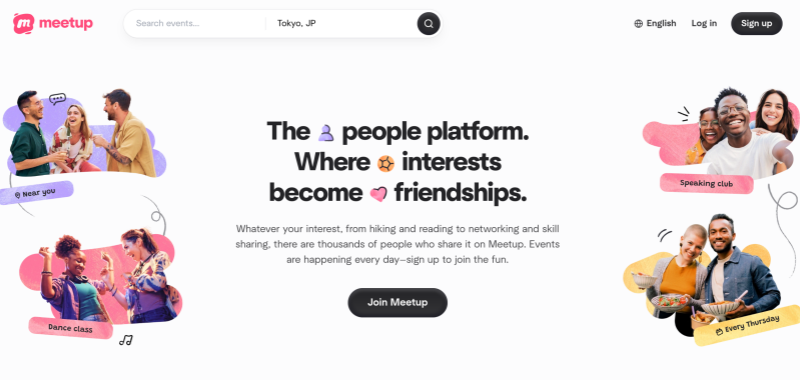
Meetup is an interest- and location-based social platform with the core goal of:
Helping people organize online and meet offline around shared interests.
Unlike social products like Tinder, Bumble, and Omegle, which focus on “matching strangers,” Meetup emphasizes long-term relationships, real-world interaction, and a sense of community. Activities on the platform include:
- Technical sharing sessions (e.g., Web3, AI, programming)
- Language exchange gatherings
- Outdoor sports (hiking, cycling, camping)
- Entrepreneurship/career development salons
- Book clubs, writing communities
- Board games, photography, meditation, yoga, etc.
Currently, Meetup covers over 180 countries and regions, with high activity levels in North America, Europe, Japan, and Singapore.
Core Features of Meetup Explained
1️⃣ Interest-Driven Activity Discovery Mechanism
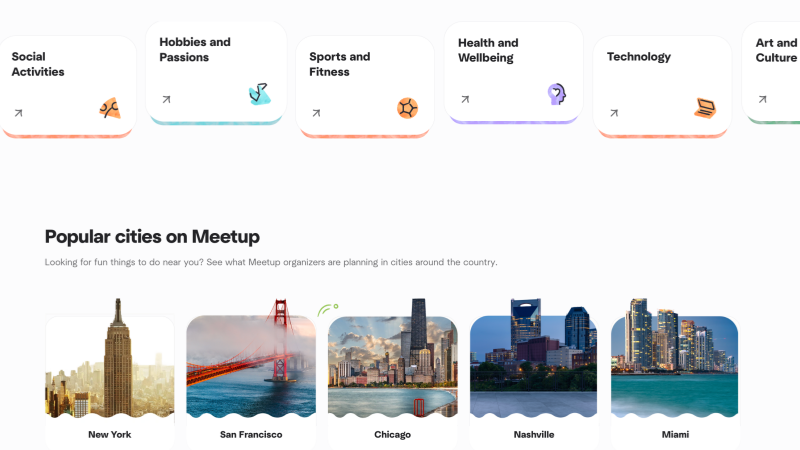
After registering, users can select multiple interest tags. Stranger Meetup will recommend local or online activities based on:
- City
- Interest preferences
- Activity popularity
- Past participation history
This mechanism weakens the “search for people” aspect and strengthens the “finding things to do” aspect.
2️⃣ Groups System
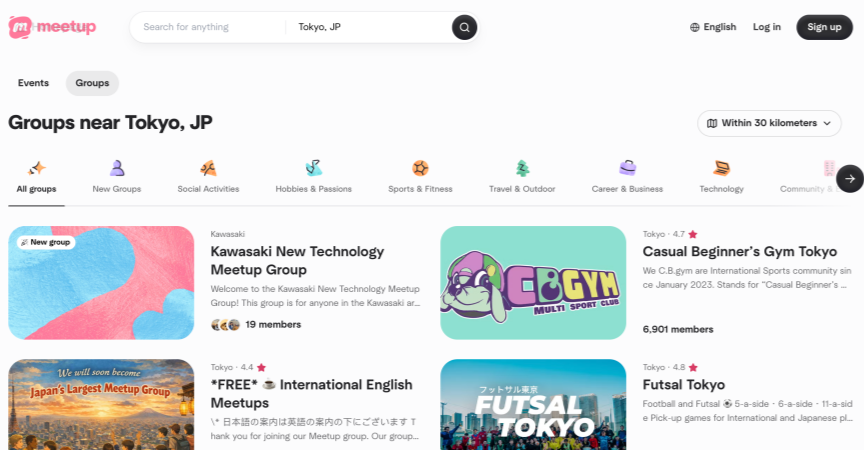
The soul of Meetup lies in its Groups.
- Each group is typically managed by an Organizer.
- They can exist long-term, continuously posting events.
- Members can discuss, vote, and leave comments within the group.
This makes Meetup more like a semi-community platform than a one-off social tool.
3️⃣ Offline + Online Events Coexist
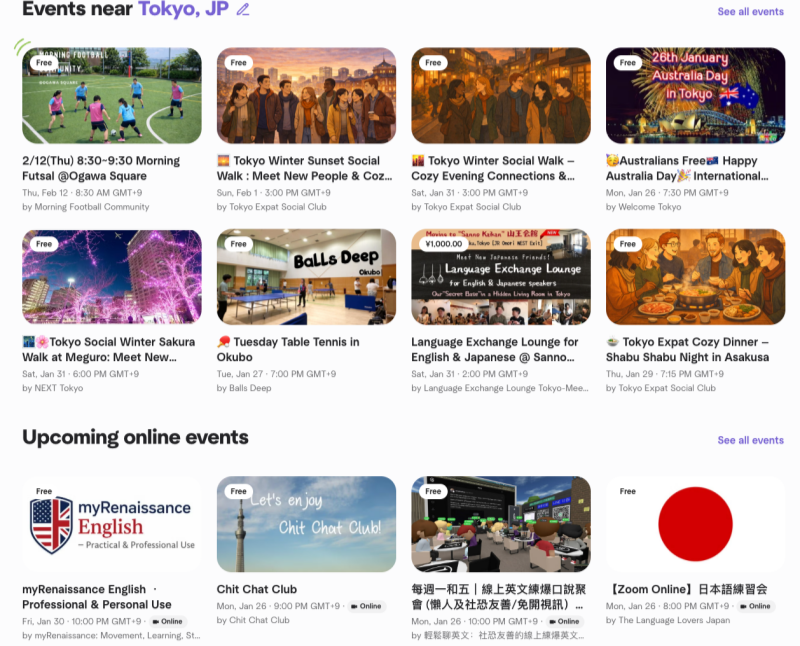
Although Meetup started with offline events, it has strengthened its offerings in recent years:
- Zoom/Google Meet online events
- Cross-city interest communities
- Hybrid events (online registration, offline participation)
This is very user-friendly for introverted users or beginners.
4️⃣ Basic Social and Messaging Functions

Meetup doesn’t primarily focus on private messaging, but it offers:
- Group chat within events
- Group announcements
- Private messaging among members (a relatively limited feature)
The overall design goal is “Participate in events first, then build relationships.”
What is the User Experience Like with Meetup?
From a practical experience perspective, Meetup’s overall style is:
- Uncomplicated functionality
- Relatively traditional UI
- More of a tool-like experience
Advantages:
- Clear event information structure
- Clear user goals (attending events, not just chatting)
- Low social pressure; no need to actively strike up conversations with strangers
Disadvantages:
- Outdated app visual design
- Low event density in some cities
- Relatively limited Chinese content and Chinese organizations
If you’re used to algorithmic social networking, Meetup may seem “slow”; however, if you’re looking for genuine connections, it’s more reliable.
Is Meetup Free?
For ordinary users:
✅ Registration and joining events are usually free
However, note:
- Some events charge organizational costs.
- The cost is set by the organizer.
For organizers:
- Creating and operating groups requires a subscription fee.
- This is Meetup’s main business model.
This model, to some extent, raises the bar for event quality and reduces spam groups.
How Secure is Meetup?
From a platform mechanism perspective, Meetup’s overall security is higher than that of random chat applications.
Reasons include:
- Emphasis on real activities and long-term groups
- More traceable user behavior
- Offline activities usually have clear themes and rules
Of course, any offline social interaction requires basic caution:
- First-time participants are advised to choose public places
- Don’t easily reveal private information
- Prioritize groups with high ratings
Overall, Meetup is more like a “social tool” than a “risky social platform.”
Who is Meetup Suitable for?
Meetup app isn’t for everyone, but the following groups will benefit greatly:
✅ Suitable for:
- Users newly arrived in a new city/country
- Those looking to expand their real-world social circle
- Introverted individuals are willing to participate in activities
- Freelancers/digital nomads
- Those wanting to build long-term relationships based on shared interests
❌ Not suitable for:
- Those who only want quick chats or flirtatious interactions
- Those seeking strong algorithmic recommendations and entertainment
- Those unwilling to participate in any offline activities
Summary of Meetup’s Advantages and Disadvantages
👍 Advantages:
- Emphasis on authentic, long-term social interaction
- Interest-driven, with clear social goals
- High-quality offline activities overall
- Suitable for building local connections
👎 Disadvantages:
- Outdated UI and product feel
- Limited activity in smaller cities
- Not suitable for instant social networking needs
Meetup Alternative: What Alternative Platforms Are Worth Considering?
While Meetup remains one of the world’s most well-known social platforms for interest-based events, not all users find it ideal, due to limited activity in some cities, organizer fees, and a slower event pace. More and more users are searching for Meetup alternatives, hoping to find a social platform that better suits their needs.
Different Meetup alternatives are suitable for different types of users. Below, we’ll categorize them according to usage purpose to help you quickly find the right alternative platform.
Best Meetup Alternatives by Use Case
1️⃣ Eventbrite – An Event-Focused, Not Social, Meetup Alternative
If your primary focus is on the local event itself, rather than long-term community relationships, Eventbrite is a common Meetup alternative.
- Covers a large number of offline events, lectures, and workshops
- More suitable for one-time participation
- Relatively weak social attributes
👉 Suitable for: Users who want to find events quickly and don’t pursue long-term social relationships.
2️⃣ Facebook Groups – A More Flexible Alternative for Interest-Based Communities
In many cities, Facebook Groups have become a viable alternative to Meetups.
- Group creation is free.
- Activity depends on the administrator.
- More focused on online discussions; offline event organization capabilities vary.
👉 Suitable for: People already using Facebook who want to participate in interest-based communities at a low cost.
3️⃣ Discord / Slack – Online Interest-Based Meetup Alternatives
For users who don’t prioritize in-person meetings, Discord and Slack are increasingly popular Meetup alternatives.
- Emphasis on long-term interaction.
- More suitable for tech professionals, creators, and remote workers.
- Offline events need to be organized independently.
👉 Suitable for: People who prefer online social interaction, international exchange, or remote communities.
4️⃣ Random Video / Instant Social Platforms – A Completely Different Alternative to Meetup
If your real reason for searching for Meetup alternatives is:
Meetups are too slow and too “formal,” and I want to meet new people more instantly.
Then you might be better off with instant video or random social platforms.
These platforms typically have the following characteristics:
- No need to attend events
- Instant matching with strangers
- Faster social pace
👉 Suitable for:
Users who want to chat quickly and meet strangers, rather than participating in long-term events.
⚠️ Note:
These Meetup alternatives generally have lower security and less social depth than Meetup itself, making them more suitable for short-term interactions.
Meetup vs Alternatives: How to Choose?
Before choosing a Meetup alternative, ask yourself a few questions:
- Do I want to attend events or meet people directly?
- Do I prefer meeting in person or communicating online?
- Can I accept a slower pace of socializing?
- Am I willing to pay for high-quality events?
If your answer is:
- ✔️ Want to build genuine, long-term relationships → Meetup is still a strong choice
- ✔️ Want faster, lighter social interaction → Meetup alternatives are more suitable
Final Thoughts: Is There a Perfect Meetup Alternative?
Strictly speaking, there isn’t a platform that completely replaces Meetup.
Because the core value of Meetup lies in:
Interest + Real-world + Long-term Community
However, if your needs change, choosing a suitable Meetup alternative can significantly enhance your social experience.
The key isn’t the platform itself, but rather:
Which stage of social interaction are you currently at?
Summary
If you ask:
Will Meetup let you make many friends overnight?
The answer is probably no.
But if you ask:
Can Meetup help you consistently meet like-minded people in the real world?
Then the answer is: Yes, and it remains one of the most reliable platforms.
In a fast-paced, superficial social environment, Meetup’s “slow” and “clumsy” nature becomes a rare value.
If you’re willing to step out of the screen and give real-world social interaction a chance, Meetup is still worth a try.
FAQs
1. Is Meetup safe?
Overall, Meetup is a relatively safe social platform.
It centers on interest groups and public events, with most interactions taking place in themed, organized groups, making it less risky than random chat or anonymous social apps.
However, because Meetup includes offline events, users still need to maintain basic safety awareness.
2. What should I be aware of when attending a Meetup offline event?
For first-time attendees of a Meetup offline event, it is recommended to pay attention to the following:
- Prioritize public places(cafes, shared spaces, outdoor parks, etc.)
- Check group activity history and member reviews
- Don’t reveal too much private information during the initial meeting
- You can leave the event at any time if you feel uncomfortable
The overall principle is: treat Meetup as a real-world social setting, not an anonymous platform.
3. Are there scammers or malicious users on Meetup?
Every open platform may have a few problematic users, but Meetup mitigates this risk through:
- Long-term group operation, organizers can manage members
- Easier tracking of activities and user behavior
- Users can report violations
- Compared to random video chat or private chat apps, Meetup carries significantly lower risk.
4. Is Meetup free?
For the average user, Meetup is essentially free:
- Account registration: Free
- Browsing activities: Free
- Joining most activities: Free
However, note that some activities may charge venue fees or organization costs, determined by the event organizer.
5. Can I only participate in online Meetup events?
Yes.
In recent years, Meetup has supported:
- Zoom/Google Meet online events
- Cross-city interest exchanges
- Remote learning and sharing sessions
This is very user-friendly for those who find offline social interaction inconvenient.
6. What is the difference between Meetup and Facebook groups?
The core difference is:
- Meetup is more focused on offline/event-oriented activities
- Facebook groups lean towards content discussion and social relationships
If your goal is to “actually meet,” Meetup is generally more effective.